
What Is an Alarm Annunciator? Complete Guide to Industrial Alarm Windows
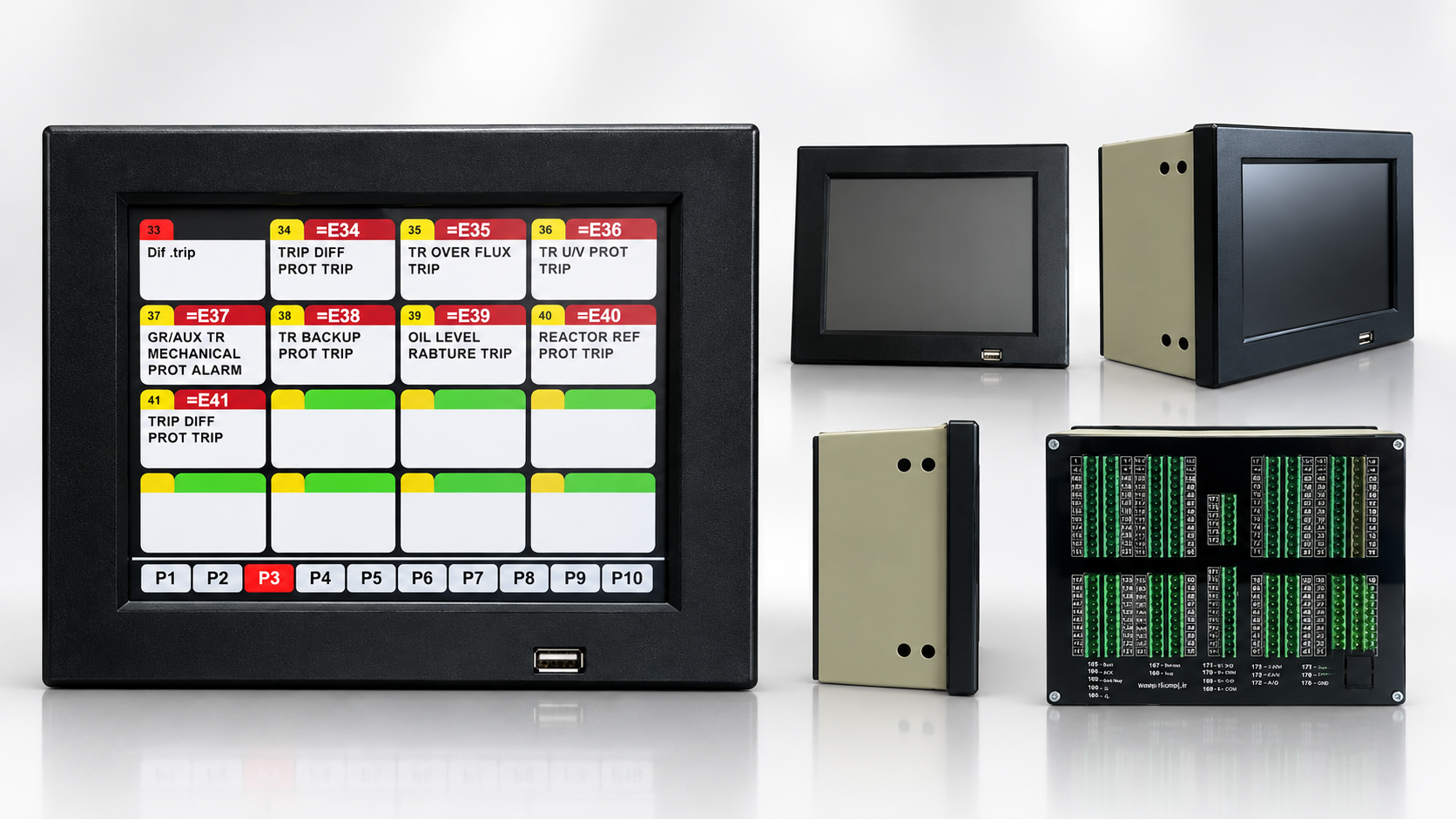
AMA500 Alarm Unit
## What Is an Alarm Annunciator?
An Alarm Annunciator, also known as an "Alarm Window" or "Alarm Unit," is a specialized device for the centralized and immediate display of abnormal conditions or faults in an industrial process, electrical substation, or power plant. Its primary function is to instantly draw the operator's attention to a critical event through visual alerts (flashing lights) and audible warnings (a horn or buzzer) and to clearly indicate the location and nature of the fault.
Unlike software-based monitoring systems that may require navigating through multiple screens, an annunciator presents vital information directly and without intermediaries on a physical panel. This characteristic makes it one of the most reliable and fastest notification tools in control rooms.
## What Is an Alarm Window?
An Alarm Window refers to each of the individual display units on the annunciator panel. In classic models, each window is a transparent or translucent tile with a lamp (usually an LED) behind it and a label describing a specific alarm. For example:
- `TRANSFORMER HIGH TEMP`
- `GENERATOR VIBRATION`
- `DC SUPPLY FAIL`
- `BREAKER 52R TRIP`
When a fault occurs, the corresponding window lights up and flashes, showing the operator exactly which part of the system is experiencing a problem. In modern annunciators, LCD or TFT screens may be used instead of physical windows, allowing for the display of full alarm text and additional information.
## Why Is It Used in Industries?
Despite the existence of advanced systems like SCADA and DCS, alarm annunciators still hold their ground in critical industries. The main reasons for this are:
- **Speed and Clarity:** The annunciator is the first and fastest layer of operator notification. A flashing light and an audible alarm grab attention much more quickly than a notification on a computer screen.
- **High Reliability:** These devices are typically hardware-based and operate independently of central computers, operating systems, and complex networks. This independence makes them immune to software crashes or network failures.
- **Reduced Operator Cognitive Load:** In a crisis, an operator may be faced with tens or hundreds of alarms on a SCADA system. By providing a physical and grouped display of key alarms, the annunciator helps the operator focus on the most critical faults.
- **Safety Requirements:** In many standards and critical industries like power generation and oil & gas, the use of an independent hardware alarm system is mandatory as a layer of safety.
## System Structure
An alarm annunciator system consists of the following main components:
### Alarm Inputs
The annunciator receives its signals from electrical contacts on various field devices. These signals are typically from [Dry Contacts](/en/knowledge/dry-contact), which are provided by protection relays, temperature sensors, pressure switches, level indicators, etc. Each annunciator input is assigned to a specific window. These contacts can be [Normally Open (NO) or Normally Closed (NC)](/en/knowledge/no-nc-contacts).
### Visual Display
The heart of the annunciator is its display panel. Different visual states convey specific information to the operator:
- **Off:** The condition is normal.
- **Fast Flashing:** A new, unacknowledged alarm has occurred.
- **Steady On:** The alarm has been acknowledged by the operator, but the fault condition is still active.
- **Slow Flashing:** In some models, this indicates that the fault has returned to a normal state before being reset.
This display sequence is known as an [Alarm Sequence](/en/knowledge/alarm-sequence), for which there are various standards, such as ISA 18.1.
### Audible Alarm
An internal or external buzzer or horn sounds simultaneously with the activation of a new alarm to attract the operator's attention, even if they are not looking at the panel.
## Operator Functions
The operator interacts with the annunciator via a few standard pushbuttons on the panel:
### [Acknowledge (Ack)](/en/knowledge/alarm-acknowledge)
By pressing this button, the operator confirms that they are aware of the alarm. This action silences the audible alarm and changes the light's state from flashing to steady on.
### [Silence](/en/knowledge/alarm-silence)
This button only silences the audible alarm, but the light continues to flash to indicate that the alarm has not yet been acknowledged. In many systems, this function is integrated with the Acknowledge button.
### [Reset](/en/knowledge/alarm-reset)
After the fault condition has been cleared (e.g., the transformer temperature has returned to normal), the operator presses the Reset button to clear the alarm from the panel, and the corresponding light turns off. This button will not function as long as the fault itself has not been resolved.
### [Test (Lamp Test)](/en/knowledge/lamp-test)
Pressing this button activates all panel lights and the horn. This is done to verify the physical integrity of the lamps and the annunciator's internal circuitry.
## Applications
### Application in Power Plants
In power plants, annunciators are used to monitor the critical status of the turbine, generator, boiler, cooling systems, and auxiliary equipment. Alarms such as excessive vibration, bearing temperature, excitation system faults, or fuel system issues are displayed directly on the annunciator panel.
### Application in Substations
In high-voltage substations, annunciators are used to monitor the status of circuit breakers, disconnectors, power and instrument transformers, the station's DC system, battery chargers, and the operation of protection relays. Immediate notification of faults like a Buchholz relay operation or a DC voltage drop is essential for maintaining grid stability.
### Application in Industries
In process industries such as petrochemicals, steel, and cement, annunciators display alerts related to pressure, temperature, level, and flow in production lines, as well as the status of large motors, pumps, and compressors, playing a significant role in Process Safety.
## Event Logging
Modern annunciators function as more than just simple displays and are equipped with event logging capabilities.
- **[First Out Alarm](/en/knowledge/first-out-alarm):** During a cascade of faults, identifying the first fault is crucial for troubleshooting. Advanced annunciators can distinguish the first incoming alarm with a special visual indication (e.g., a different flashing rate).
- **[Sequence of Events (SOE)](/en/knowledge/sequence-of-events-soe):** This feature allows the annunciator to log a list of all events (alarm activations and deactivations) with a highly accurate timestamp, typically with a resolution of 1 millisecond. This log is invaluable for post-mortem analysis and finding the root cause of trips.
## Communication with Monitoring Systems
Many of today's alarm units feature communication ports (like RS485) and support for standard industrial protocols such as Modbus and IEC 60870-5-101. This allows them to send the list of alarms and logged events to higher-level systems like SCADA, DCS, or RTUs. This way, information is visible both locally in the control room and centrally at the dispatching center.
## Difference Between Alarm, Warning, Fault, Event, and Trip
These terms are often used interchangeably, but they have distinct meanings. For a better understanding, read the article "[Difference Between Alarm, Warning, Fault, Event, and Trip](/en/knowledge/alarm-warning-fault-event-trip)". Below is a summary and a comparison table:
- **Event:** Any detectable change of state in a system. An event can be normal or abnormal (e.g., a breaker closing).
- **Fault:** A physical defect or abnormal condition in a component (e.g., a short circuit in a motor winding).
- **Warning:** An abnormal condition that is approaching a critical state but has not yet crossed the threshold. It requires operator attention but not immediate action (e.g., "Transformer oil temperature has reached 75°C").
- **Alarm:** A critical abnormal condition that requires immediate operator action (e.g., "Transformer oil temperature has reached 90°C").
- **Trip:** An automatic protective action that shuts down or disconnects equipment to prevent damage (e.g., the protection relay sends a trip command to the transformer's breaker due to the 90°C temperature).
| Term | Definition | Industrial Example | Requires Immediate Action |
|---|---|---|---|
| **Event** | Any detectable change of state | Panel door opened | No |
| **Fault** | Physical defect in equipment | Blown fuse | Depends on its effect |
| **Warning** | Approaching a critical condition | Increased pump vibration (yellow range) | No, but requires investigation |
| **Alarm** | Exceeding a critical threshold | Tank pressure above maximum limit | Yes |
| **Trip** | Automatic protective action | Breaker tripped by overcurrent relay | The system has already acted |
## Can SCADA Replace an Alarm Annunciator?
This is a common question in the design of modern control rooms. The short answer is: "Not always." Although SCADA systems have extensive alarm management capabilities, an annunciator offers unique advantages. These two systems are not competitors; they are complementary.
- **SCADA:** Ideal for comprehensive monitoring, trend analysis, large-scale data logging, and centralized control.
- **Annunciator:** Unmatched for immediate, reliable, and unambiguous notification of critical faults at the local level.
In many critical facilities, both systems are used simultaneously to achieve the highest level of safety and reliability. For a full discussion, please refer to the article "[Alarm Annunciator vs. SCADA](/en/knowledge/annunciator-vs-scada)".
## Frequently Asked Questions (FAQ)
### What is the first step to take after seeing a new alarm?
The first step is to press the Acknowledge button. This action informs the system that you are aware of the fault, silences the audible alarm, and allows you to investigate and resolve the issue with better focus.
### Why is 1ms timestamp resolution important in SOE logging?
In power systems, many protective events happen within a few milliseconds. For example, the operation of a protection relay and its subsequent trip command to a breaker might take less than 20 milliseconds. Without high-resolution timing, determining the correct sequence of these events and finding the root cause of an incident would be impossible.
### Can an alarm annunciator work without a computer?
Yes, one of the biggest advantages of annunciators is their standalone operation. They are wired directly to sensors and relays and do not require a computer, network, or special software to display primary alarms.
## Related Products from Rizmoj Electric Toos
Rizmoj Electric Toos, as a specialized manufacturer of monitoring and control equipment in Iran, offers a wide range of [Alarm Units and Annunciators](/en/products/alarm-units) for various industrial, power plant, and substation applications.
For modern projects requiring high input capacity, a graphical display, and advanced event logging features, the [AMA500 series Alarm Unit](/en/products/ama500) is an ideal choice. With its 8-inch color touch screen, input capacity of up to 160 channels, Sequence of Events (SOE) logging with 1ms resolution, and support for Modbus and IEC 60870-5-101 communication protocols, this device meets all the needs of an advanced monitoring system.
For applications that require a classic, centralized window display, the [AMA-535 35-Window Alarm Annunciator](/en/products/ama-535) provides a reliable and efficient solution for the quick display of alarm statuses on control panels. More compact models like the [AMA520](/en/products/ama520-alarm-unit) and [AMA524](/en/products/ama524-alarm-unit) are also available for applications with fewer inputs and the need for communication with RTU systems.
## Related Articles
- [How Does an Alarm Window Work?](/en/knowledge/how-alarm-window-works)
- [What Is a First Out Alarm?](/en/knowledge/first-out-alarm)
- [What Is a Sequence of Events (SOE)?](/en/knowledge/sequence-of-events-soe)
- [Alarm Annunciator vs. SCADA](/en/knowledge/annunciator-vs-scada)
- [What Is Acknowledge in an Alarm System?](/en/knowledge/alarm-acknowledge)